BIS Report: Basel III Set to Apply in Almost All Jurisdictions by 2027
Three quarters of the Basel Committee's 27 members have published final Basel III rules, and almost all will apply them by April 2027, after a 2023 target.
International banking standards are agreed in one place and applied in another. The Basel Committee on Banking Supervision writes the rules, but each of its member jurisdictions has to turn them into domestic law, and the pace at which that happens determines whether banks in different countries compete on equal terms. On October 5, 2026, the Committee published its latest progress report on adoption of the final Basel III standards. The BIS report reaches a notable milestone, since almost all of its members have now announced that banks must apply Basel III by April 2027 or earlier, more than four years after the original date.
Where adoption stands
The update and its monitoring dashboard describe the position as of the end of September 2026. Three quarters of the Committee’s 27 member jurisdictions have published rules adopting the full set of final Basel III standards, meaning every standard with an implementation date of January 1, 2023. The framework includes the final elements the Committee published in December 2017 and the finalized minimum capital requirements for market risk of January 2019.
Implementation in force is further along for some parts than for the whole. The revised credit risk and operational risk standards, along with the output floor, are already effective in around 85% of member jurisdictions. The output floor is the provision that limits how far a bank’s internal-model calculations can lower its risk-weighted assets below the results of the standardized approach.
Looking ahead, the Committee said that almost all member jurisdictions have publicly announced that banks must apply Basel III by April 2027 or earlier. The dashboard records the publication and implementation dates of each member’s domestic regulations, so the details of individual jurisdictions are there.
A long timetable
The original implementation date for these reforms, as announced by the Governors and Heads of Supervision (GHOS), the Committee’s oversight body, was January 1, 2023. That date was set in March 2020. By the end of September 2026, the Committee’s own figures show that about a quarter of members had yet to publish final rules, and almost all members had set an application date no later than April 2027.
Two features of the Basel process explain the gap. The first is that the standards are not self-executing. The Committee has no power to impose them; it relies on members to adopt them through legislation or regulation, and the Committee reviews the results. The second is the volume of work involved. Rules on credit risk, operational risk, market risk and the output floor affect how banks calculate their capital in nearly every business line, so national authorities consult, draft and phase in changes over a period of years.
Three stages of adoption
The release uses three different measures, and they should not be conflated. Publication means a jurisdiction has issued its final rules, and three quarters of members have done so for the full set. Effectiveness means the rules already bind banks, which is true of the revised credit risk and operational risk standards and the output floor in around 85% of members. Application means the date by which banks must comply, and for almost all members that date is April 2027 or earlier. A jurisdiction can sit at different stages for different standards, which is why the dashboard tracks publication and implementation dates standard by standard.
The sequence also shows that the later stages are more advanced than the first. More members have the main standards in force than have published rules for the entire package, which means publication of the complete package is the stage still outstanding in the remaining quarter of jurisdictions.
The Committee’s position
The release recalls what the GHOS said at its meeting on March 9, 2026. Members at that meeting welcomed implementation progress and reaffirmed their expectation of full, consistent implementation of Basel III by all member jurisdictions as soon as possible. The GHOS tasked the Committee with continuing to monitor and assess implementation.
The Committee’s justification is stated in a single sentence. The series of shocks to financial markets over the past few years, and recent market developments, have highlighted the importance of a prudent global regulatory framework and a regulatory level playing field. The phrase “level playing field” is the key one. A bank in a jurisdiction that applies the rules fully carries a different capital burden from a competitor in a jurisdiction that has not, and uneven timing can shift where business is booked.
How the progress report relates to the monitoring exercise
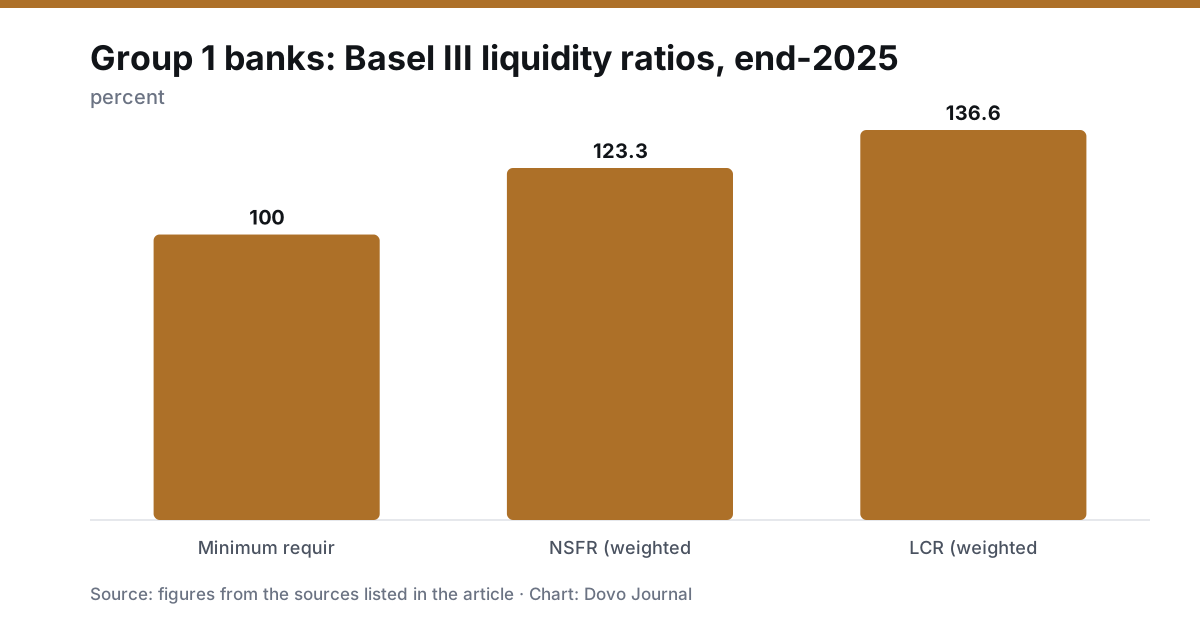
The adoption data complement the Committee’s regular monitoring exercise, which measures the effect of the standards on bank balance sheets. The latest of those reports, published on September 23, found stable risk-based capital and leverage ratios for large internationally active banks at the end of 2025, with an average impact of +2.2% on Tier 1 minimum required capital under the fully phased-in framework. One report measures what the rules would require of banks; the other measures how many jurisdictions have made them binding. Read together, they show a framework that is mostly adopted and that, on the Committee’s sample, large banks are largely positioned to meet, with Group 1 banks reporting a capital shortfall of €1.2 billion.
The pairing is the useful way to read the October release. A high adoption rate does not by itself say whether the rules are applied in the same way, and the Committee’s emphasis on “full and consistent” implementation reflects that concern. The progress report establishes the first fact on which any such judgment depends, which is which standards are in force where.
What to watch
The headline for the coming months is whether April 2027 holds. The Committee said “almost all” members have announced that date or earlier, so the remaining members are the ones to watch, as is any slippage among those that have set dates. The dashboard will show changes as jurisdictions publish final rules. Beyond adoption, attention will shift to how the standards operate in practice, including how national authorities treat provisions that offer discretion and how banks respond when transitional arrangements end on January 1, 2028.
For central bank policy, the practical meaning is stability. If the April 2027 dates hold, banks in nearly all member jurisdictions will operate under the same set of rules, and that gives authorities a common base from which to judge capital adequacy and financial stability across borders.
Prepared with AI assistance from public sources and reviewed under our editorial policy. Not investment advice.